
Keurig Sync
Making everyday coffee a little easier.
Designing a connected coffee experience around the routines people already have.
ROLE
UX Research & UX/UI Design
UX Research + Interaction Design
METHODS
6 User Interviews + Usability Testing
METHODS
6 User Interviews + Usability Testing
TIMELINE
Semester Project
Sep–Dec 2025
DELIVERABLES
Research, Branding, UX/UI Design
Research Synthesis + User Flows + Wireframes + Interactive Prototype
The Problem
Making coffee should feel effortless.
Every morning, users had to make the same choices again: cup size, strength, and when they wanted their coffee.
For something people do every day, the process required more thought than it should.
The goal was to make that routine simpler.
Making coffee should feel effortless.
Making coffee is a small everyday routine, but the same choices can add up every morning.
I wanted to understand which parts of the process people repeated, where they slowed down, and what could be simplified.


Understanding the Routine
I looked at how people make coffee every day, what slows them down, and where the experience could be simpler.
I spoke with six people about how they make coffee, what slows them down, and what they would actually want from a connected coffee experience.
01

Morning starts the same
Coffee is part of the morning routine.
02

Brewing should feel easy
No one wants extra steps in the morning.
03

Too many choices create friction
Too many settings make things feel harder.
04

The same choices kept repeating
People were making the same decisions every morning.
05

The routine could do more of the work
Saving preferences and planning ahead could reduce repeated effort.
01
Morning starts the same
Coffee is part of the morning routine.
02
Brewing should be effortless
No one wants extra steps in the morning.
03
Too many choices create friction
Too many settings make things feel harder.
04
Research revealed an opportunity
Daily choices don’t need to happen again.
05
The routine could do more of the work
Saving preferences and planning ahead could reduce repeated effort.
Personas
These personas are based on two participants from my interviews and reflect different morning routines, needs, and frustrations.

Alex
25 • Graduate Student
“I just want good coffee before class. I don’t have time to figure out the settings.”
NEEDS
Brew coffee in one tap
Simple, intuitive controls
Compact for a small apartment
PAIN POINTS
Too many settings
Limited time before class
Cleaning takes too long

Sarah
31 • Marketing Manager
“My mornings are busy. I just want my coffee ready when I wake up.”
NEEDS
Automatic weekday schedule
Reliable coffee every morning
Easy schedule adjustments
PAIN POINTS
Updating schedules manually
Forgetting to adjust routines
Coffee isn't ready on time
Personas
PAIN POINTS
Too many settings
Limited time before class
Cleaning takes too long
NEEDS
Brew coffee in one tap
Simple, intuitive controls
Compact for a small apartment
Alex
25 • Graduate Student
“I just want good coffee before class.
I don’t have time to figure out the settings.”
These personas are based on two participants from my interviews and reflect different morning routines, needs, and frustrations.
Sarah
31 • Marketing Manager
“My mornings are busy. I just want my coffee ready when I wake up.”
NEEDS
Automatic weekday schedule
Reliable coffee every morning
Easy schedule adjustments
PAIN POINTS
Updating schedules manually
Forgetting to adjust routines
Coffee isn't ready on time
Key Insights
Our research revealed three key insights that guided the design.
01
Same routine, every day
People made their coffee the same way each morning.
02
Customization added friction
Too many settings made a simple routine feel harder.
03
Convenience mattered most
People wanted their coffee ready with less effort.
Design Principles
The research helped focus on three things throughout the design.
Reduce Decision Load
Keep the interface focused, with fewer choices and one clear next step.

Fewer decisions
Clear visual hierarchy
One clear primary action

Support Repeated Routines
Let users save and schedule the things they do daily.

Save preferred brew settings
Schedule brewing in advance
Repeat scheduled brews
Make System Status Clear
The app makes it easy to see when the machine
needs maintenance and what to do next.

Brewing progress updates
Clear maintenance alerts
Machine status
Key Insights
Our research revealed three key insights that guided the design.
01
Same routine, every day
People made their coffee the same way each morning.
02
Customization added friction
Too many settings made a simple routine feel harder.
03
Convenience mattered most
People wanted their coffee ready with less effort.
Design Principles
The research helped focus the experience around three simple principles.
The research helped focus on three things throughout the design.
Reduce Decision Load
Keep the interface focused, with fewer choices and one clear next step.
Fewer decisions
Clear visual hierarchy
One clear primary action
Support Repeated Routines
Let users save and schedule the things they do daily.
Save preferred brew settings
Schedule brewing in advance
Repeat scheduled brews
Make System Status Clear
Maintenance alerts, brewing progress, and clear machine status make the next step easy to understand.
The app makes it easy to see when the machine needs maintenance and what to do next.
Brewing progress updates
Clear maintenance alerts
Machine status
Final Design
The final experience brings quick brewing, thoughtful scheduling, and machine care into one connected coffee routine.
The final concept brings those principles together across three parts of the experience.
Coffee that fits your routine
Keurig Sync makes it easy to brew now, plan ahead, and keep your machine running smoothly.
Quick Brew
Smart Scheduling
Machine Care

Coffee that fits your routine
Keurig Sync makes it easy to brew now, plan ahead, and keep your machine running smoothly.
Quick Brew
Smart Scheduling
Machine Care

Make it your own
Choose your coffee, adjust it the way you like, or schedule it for later.
Choose a coffee
Customize your brew
Schedule for later
Take care of your machine
See when your machine needs attention and what to do next.
Machine Health
Sustainability
Know when maintenance is needed.
Track water, energy, and recycling impact.

Make it your own
Choose your coffee, adjust it the way you like, or schedule it for later.
Choose a coffee
Customize your brew
Schedule for later
Usability Testing
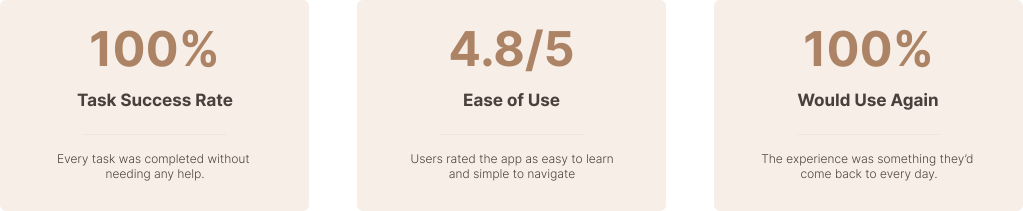
I tested the final prototype to see how easily users could complete the main tasks.
100%
Task Success Rate
Every task was completed without needing any help.
4.8/5
Ease of Use
Users rated the app as easy to learn and simple to navigate.
100%
Would Use Again
The experience was something they’d come back to every day.
Take care of your machine
See when your machine needs attention and what to do next.
Machine Health
Sustainability
Know when maintenance is needed.
Track water, energy, and recycling impact.
What I Learned
Keurig Sync changed how I think about simplification. I learned that making an experience easier isn’t just about removing options. It’s about understanding which decisions people actually want to make and which ones they shouldn’t have to repeat
every day.
Usability Testing
I tested the final prototype to see how easily users could complete the main tasks.
100%
Task Success Rate
Every task was completed without needing any help.
4.8/5
Ease of Use
Users rated the app as easy to learn and simple to navigate.
100%
Would Use Again
The experience was something they’d come back to every day.
What I Learned
Keurig Sync changed how I think about simplification. I learned that making an experience easier isn’t just about removing options. It’s about understanding which decisions people actually want to make and which ones they shouldn’t have to repeat every day.
Explore the Project
Explore the Project
These personas are based on two participants from my interviews and reflect different morning routines, needs, and frustrations.
I spoke with six people about how they make coffee, what slows them down, and what they would actually want from a connected
coffee experience.
Personas
METHODS
6 User Interviews + Usability Testing
DELIVERABLES
Research Synthesis + User Flows
+ Wireframes + Interactive Prototype
Making coffee should feel effortless.
Making coffee is a small everyday routine, but the same choices can add up every morning.
I wanted to understand which parts of the process people were repeating, where they were getting slowed down, and what could be simplified.
ROLE
UX Research + Interaction Design
TIMELINE
Sep–Dec 2025
Understanding the Routine
The Problem
01
Morning starts
the same
Coffee is part of the morning routine.
02
Brewing should
feel easy
No one wants extra steps in the morning.
03
Too many choices create friction
Too many settings make things feel harder.
Compact for a small apartment
Simple, intuitive controls
Brew coffee in one tap
Cleaning takes too long
Limited time before class
PAIN POINTS

NEEDS
25 • Graduate Student
Alex
"I just want good coffee before class.
I don't have time to figure
out the settings."
Too many settings

Updating schedules manually
"My mornings are busy. I just want my coffee ready when
I wake up."
Sarah
31 • Marketing Manager
NEEDS
PAIN POINTS
Forgetting to adjust routines
Coffee isn't ready on time
Easy schedule adjustments
Reliable coffee every morning
Automatic weekday schedule
04
The same choices kept repeating
People were making the same decisions every morning.
05
The routine could do more of the work
Saving preferences and planning ahead could reduce repeated effort.

01
Same routine,
every day
People often made their coffee the same way each morning.
02
Customization added friction
Too many settings made a simple routine feel harder.
03
Convenience mattered most
People wanted their coffee ready with less effort.
These patterns pointed to three design opportunities.
Key Insights
Design Principles
The research helped me focus on three things throughout the design.
Fewer decisions
Clear visual hierarchy
One clear primary action
Keep the interface focused, with fewer choices and one clear next step.
Reduce
Decision Load
Support
Repeated Routines
The app makes it easy to see when the machine needs maintenance and what to do next.
Make System Status Clear
Keurig Sync
Designing a connected coffee experience around the routines people already have.


Choose a coffee
Customize your brew
Schedule for later
Make it your own


Choose your coffee, adjust it the way you like, or schedule it for later.
Coffee that fits your routine
The home screen brings brewing, scheduling, and machine care into one place.
Track water, energy, and recycling impact.
Know when maintenance is needed.
Quick Brew
Smart Scheduling
Machine Care
Machine Health
Sustainability
Take care of your machine
See when your machine needs attention and what to do next.

Explore the interactive prototype and key user flows.
I tested the final prototype to see how easily users could complete the
main tasks.
Usability Testing
Keurig Sync changed how I think about simplification. I learned that making an experience easier isn’t just about removing options. It’s about understanding which decisions people actually want to make and which ones they shouldn’t have to repeat every day.
What I learned
Explore the Project
Save preferred brew settings
Schedule brewing in advance
Repeat scheduled brews
Let people save and schedule the choices they make most often.
Brewing progress updates
Clear maintenance alerts
Machine status
Final Design
The final concept brings those principles together across three parts of the experience.